The advantage of having a daughter with a keen interest in Marvel films, is that there is no risk of me seeing them in the wrong order. She has worked out that the schedule of filming laid out will last until she is 33 years old (and she is only 19 at the moment).
Today it was my turn to see Captain America 2, or as I like to think of it Captain America 2.5 since the first avengers film neatly bissects the timeline between CA1 and CA2. What is clear is that some great mind (or minds) has charted out a two decade vista of Marvel films that will enthrall us. The apollo space programme took less time - and probably cost less money. So, in this film there are seeds planted and threads picked up for those willing to see them. This is not a series, so much as a web of films which puts me in mind of Terry Pratchett's discworld novels for its intersecting story lines and cast of co-equal principals.
I will endeavour to be spoiler free. However, I should warn all those of you waiting in the UK for the next Agents of Shield series (please don't ask me which number - I must confess to having already lost count), it would be best to see Captain America 2, before accessing agent Coulson and his hardy band.
So what does Captain America 2 bring to the mix.
Well the first film was set predominantly in the safe territory of world war two where good was good and bad was bad and everybody knew the difference. Even so, the film had to invent a new evil entity since the Nazis weren't nearly nasty enough. Hence we had Hydra and a colourful red skinned warrior who was the first unfortunate result of Captain America's Ultimate soldier treatment going wrong. (The second being I understand the incredible hulk. The red skin and green skin make for a concept as colourful and as tasty as the sauces that came with our Saturday night Indian take away).
In the second film the action is all contemporary, that is to say as contemporary as you can be in a world which openly accepts the existence of super heroes and has just survived an alien invasion orchestrated by a God.
The action is fast paced, opening with a hostage rescue mission during which agent Romanov insists on listing suitable girls for Rogers to date. When he suggests she concentrates on her mission she blithely asserts "I'm multi-tasking." Captain America's love life stalled by over half a century is a recurring theme at one point he excuses any failings perceived or real with the observation "I am 95" and for a near centurion he does look pretty hot - or so I am reliably informed by those who should know.
The dialogue is sharp and spare, the scenes well cut. It is 136 minutes long, but it doesn't feel like it. At one point our heroes have to retrieve some item locked in a secret compound with many guards and steel doors, but we are not shown how that happens, a simple line "no problem" is enough to let us know it can and will be solved and sure enough the artifact arrives on perfect cue to raise the tempo.
However, there is a darkness beneath the sharp lines and ready action. The enemy here is hard to perceive and Director Fury's advice to Captain Rogers to trust no-one is sound. This is a world where everybody is in such a hurry to pack the best protection possible, they have lost sight of whose finger might end up on the trigger. Like people carrying a weapon for protection, such as Fury's grandad who carried a loaded magnum as proof against a mugging, you can never know whether somebody might turn the weapon on you. And in the same way the surveillance culture comes under scrutiny as the film questions who might gain access to what information and to what purpose. If Big Brother is watching you, and he's got a big gun, who's watching him?
And in the midst of this, Rogers is the moral throw back to an earlier age of simpler values facing simpler threats. A soldier left questioning if following orders is still right or not. And to keep him going there is the morally compromised Agent Romanov, battling her own checquered past while engaging in a banter with Captain America that makes you hope and wish they don't fall into the "just good friends" trap.
My quibbles with the film - the points where suspension of disbelief was required ? Well, I could just about cope with the violation of several laws of physics, mainly forgetting that no crash happens in slow motion and certainly not slower than a man can run. When a thousand tons of steel fall from a great height you get a thin smear of metal dust and slime that no-one walks away from, rather than a coherent whole.
My other gripe is when the sensitive electronic equipment on a superslaying drone machine is dangled from what seems to be some steel threaded net sack below the vessel. It is a sighting as stupid and as vulnerable as nature's placing of a man's valuables - who knows, maybe the electronics needs a cooler temperature to operate in. Certainly our heroes know where to kick and to kick hard!
Who are the bad guys in the film? well, let me put this way. You may know how Nazi Germany had a spectacularly poor way of choosing the code names for its secret operations relying on none too subtle references to Norse mythology. Like, for example, their radar research went under the code name of Heimdall the far seeing guardian of Asgard, not too hard for the guys at Bletchley park to crack what that was all about! Well in the same way a group named Hydra! kinda hard to kill, two heads better than one and all that - just saying.
And then there is the winter soldier. When your hero is as tough as Steve Rogers, you need somebody equally tough to stand up to him and the winter soldier does not disappoint. Wearing a face mask scarcely less obscuring than Jason Vorheis he strides through the smoke with an ominous menace walking out of a dark past into a brutal present, but who knows with Marvel films mapped out for the next umpteen years his future, along with every other dead guy's is surprisingly bright.
Sunday, 6 April 2014

Thursday, 27 March 2014
The Girl With all the Gifts (Spoiler free) review
This was another book that consumed me. It has that same kind of disconnection that aberrant normality with which Orwell's classic 1984 opens. For Orwell's Winston Smith, the clocks striking 13 at the end of the opening line. For Carey's Melanie it is the idea of a child in a prison, a child who must be strapped into a restraining chair before she can be taken to class, a child for whom all this is nothing more than she expects. She endures the unendurable with the innocent acceptance of one who knows nothing else. But all things change and the onion layers of the world that M.R.Carey has created are gradually peeled back with surgical precision.
The story is told predominantly in the present tense and this kind of feature usually annoys me - it can feel amateurish. In Carey's hands it is an effective device to make the story more edgy. We see the tale unfold from five different points of view. For me, the fact that all of them speaking to the reader in the present tense giving no reassurance that this is reflection on a tale that has been safely consigned to their past.
All five voices are beautifully rendered, faithful to the drives and motivations of the characters yet allowing each one to grow and adapt to teh changing currents of the story. Most notably including the eponymous heroine - our would-be Pandora. She is a child of imprisonment, an utter innocent, and yet gifted with an intelligence beyond that of all the adults around her. It is a difficult persona to present convincingly and it is to Carey's credit that he manages it so effectively.
The other characters are portrayed with equal clarity, their obsessions and their preoccupations, and after Melanie, I think my favourite is the Sergeant for these are the two whose journey most enthralled me.
The Girl with all the Gifts set off associations in my mind with other books, a touch of Roald Dahl's Matilda, a brief hint of Emma Donoghue's "Room" all stirred in with a healthy dose of every post apocalyptic nightmare story there's ever been.
The writing is crisp and economical, no words wasted, nothing you can skip or skim or even put down.
I have read two great books in under a week and must be wary of starting another of such quality, for fear that I will lose all touch or interest in the real world.
I'm still thinking about the book a day after finishing it, haunted by thoughts and the references in the plot that unleash little echoes or after-shocks. It is a clever intricate story that works well. Its threads get into your mind and bind you to it!
The story is told predominantly in the present tense and this kind of feature usually annoys me - it can feel amateurish. In Carey's hands it is an effective device to make the story more edgy. We see the tale unfold from five different points of view. For me, the fact that all of them speaking to the reader in the present tense giving no reassurance that this is reflection on a tale that has been safely consigned to their past.
All five voices are beautifully rendered, faithful to the drives and motivations of the characters yet allowing each one to grow and adapt to teh changing currents of the story. Most notably including the eponymous heroine - our would-be Pandora. She is a child of imprisonment, an utter innocent, and yet gifted with an intelligence beyond that of all the adults around her. It is a difficult persona to present convincingly and it is to Carey's credit that he manages it so effectively.
The other characters are portrayed with equal clarity, their obsessions and their preoccupations, and after Melanie, I think my favourite is the Sergeant for these are the two whose journey most enthralled me.
The Girl with all the Gifts set off associations in my mind with other books, a touch of Roald Dahl's Matilda, a brief hint of Emma Donoghue's "Room" all stirred in with a healthy dose of every post apocalyptic nightmare story there's ever been.
The writing is crisp and economical, no words wasted, nothing you can skip or skim or even put down.
I have read two great books in under a week and must be wary of starting another of such quality, for fear that I will lose all touch or interest in the real world.
I'm still thinking about the book a day after finishing it, haunted by thoughts and the references in the plot that unleash little echoes or after-shocks. It is a clever intricate story that works well. Its threads get into your mind and bind you to it!
Monday, 24 March 2014
Review of Prince of Fools (Spoiler Free)
I was lucky enough this week to get an ARC of Prince of Fools which was here when I got home from work on Thursday and which I have just finished two days later in some rather intensive reading. Loved it. Gave it five stars and have posted a review on Goodreads.
I have also copied the review below.
In his afterthought at the end of Emperor of Thorns Mark Lawrence reflected on the risk he took in deciding that the Thorns works (unlike the Hitchhiker's guide to the Galaxy) would indeed finish emphatically and conclusively as the trilogy that the story demanded. In considering whether he should have surrendered to commercial opportunism and dragged more books out of our favourite anti-hero he wrote "in years to come when I'm eating cat food cold from a tin I may wish that I had." Well, Jorg's story may have been brilliantly told, but Jalan's is just beginning and I have to say there is no risk whatsoever of Mr Lawrence eeking (or eking) out his years on unheated petfood.
For a book that has parenthood as one of its many themes, it is perhaps invidious to start by comparing Jalan to Jorg. No child likes to be compared to their siblings, preferring any judgement to be based on the absolutes of their own merits, rather than the relative ones of their relatives. But for those of us who came to Lawrence's writing through the intoxicating wickedness of Jorg Ancrath, it is important to see if that magic could be sustained in a different vessel.
What is there that people will recognise?
Well there is the elegant simplicity of the writing. Mr Lawrence does not batter the reader around the head with the size of his vocabulary, he simply arranges words and sentences in ways that entrance and surprise. This is a book which is impossible either to skimread or to put down, and readers would be well advised to start this at the beginning of a weekend where they have plenty of free-time (and an understanding family). Jorg gave us more quotable quotes per chapter than any of the contemporary works of fantasy fiction. Short pithy statements that turn our thinking on its head and reveal a truth we always knew but had not seen. There is enough in Prince of Fools to spawn another welter of poster contests as readers seek to find an image to harmonise with the words.
A couple of examples that tickled me were these - but I am sure quotes will sprout up like spring daffodils across the pages of Goodreads once the book is officially released.
"Enjoy the world while you can I say. A shallow enough philosophy by which to live, but shallow is what I've got. Besides deep is apt to drown you."
"It's good to steer a man in the direction they want to go. It blurs the line between what he wants and what you want."
There is also the persuasive perspective of the first person point of view. You can not know a man until you have walked a mile in their shoes, or read 500 pages in their head. All people, be they heroes, cowards or criminals believe their actions to be the best most sensible response to the situations they find themselves. We came to a grim understanding of the moral free id that was Jorg, we also come to a grudging admiration for the decadence driven dandy that is Jalan.
The glimpses of a post apocalyptic society that has sunk into medieval magic and necromancy provides a fascinating backdrop and opportunities for us to see so many familiar objects in unfamiliar ways.
There are also some familiar faces, characters that walked the Broken Empire with Jorg are seen here from a different angle. Jalan's story runs side by side with Jorg's their paths crossing but not quite touching, as though two zig-zagging paths of light and dark ran side by side.
There is also the character driven nature of the plot, our heroes hack their way through the landscape shaping the story by the force of their personalities.
But while there is that similarity of style, stature and setting for the writing, that reassuring family resemblance between the Prince of Fools and the Prince of Thorns, there are also differences.
Jalan, though imbued with much of Jorg's eloquence and wit, is a character of quite a different mettle. The opening scenes of both books set the tone for their leads. We met Jorg in the aftermath of a conquest and learned of his cold dead heart through his reactions to it. We meet Jalan also fresh from a conquest of his own, and similarly drawn in by the passion and the peril that his pre-occupations engender.
Jalan is an anti-hero in a different mould and his journey is a different kind of one. Jorg was returning home, when we met him his road journey reaching its conclusion. Jalan's is about to start.
Jorg commanded the stage like Shakespeare's Richard III, casting a shadow over the other players. We loved Makin but we saw him as Jorg's foil, his conscience sometimes, but never his equal. Jalan shares the limelight with Snorri, a man with his own story and with more than enough heroism for two men - which in the circumstances is quite fortunate.
(by the way, to cope with my own Jorg withdrawal symptoms I did a 1500 word Jorg short as part of the fantasy-faction March short story competition on the theme of fan-fic. Entry 6 "The Road to Arrow" )
Saturday, 1 March 2014
I'm Running up that Hill
It struck me this morning, as I tried to clear the decks of all the extraneous business of everyday life that gets in the way of writing, that writing a story is a bit like climbing a mountain. Please note from my title that I'm thinking more of Kate Bush than Julie Andrews as the musical accompaniment to this piece.
I know for some authors the writing process is a journey of discovery. They have in mind an interesting situation and combination of characters and essentially let the story follow its own course. For them, I suspect, the writing process is like hacking through the amazonian jungle and uncovering secrets they hadn't even thought of at the start, like stumbling upon some abandoned machu picchu site.
For me the plot came first. I had an idea always of the end point. It loomed like the summit of a mountain at once extremely visible and yet by its distance, dimly perceived.
Writing the bloodline trilogy has been a process of climbing that mountain. Along the way there have been unexpected mini-peaks, the odd cravasse and some narrow ridges along which I have had to tread warily. At this point perhaps I should admit that my mountaineering exploits are limited to reaching the top of a stepladder in order to fix a satellite dish with duct tape. Hence we may have reached the limit of my ability to exploit this analogy, or at least to do so without offending anyone with a more than passing acquaintance with crampons (whatever they are).
Anyway, what fascinates me is how the detail in that snow capped peak becomes more apparent as I draw near. I am 36,000 words into Master of The Planes, which will conclude the trilogy. While my certainty about the endpoint is unchanged, the precise line of final ascent is shifting. New opportunities emerge. Characters I had originally envisaged as discardable extras to illuminate the strengths and weaknesses of the protaganists, suddenly remerge and assume pivotal importance as all trails, no matter how they may lift and separate, all lead to the peak. And the story feels so much the better for it as various different arcs share a common climax (no sniggering at the back there).
So, as I scamper hopefully towards the end of part one (of five), I find myself thinking that maybe I am not so different from those jungle slashing plotting-phobics as I thought. A bit of Dr Livingstone, just as much as Sir Edmund Hilary.
I know for some authors the writing process is a journey of discovery. They have in mind an interesting situation and combination of characters and essentially let the story follow its own course. For them, I suspect, the writing process is like hacking through the amazonian jungle and uncovering secrets they hadn't even thought of at the start, like stumbling upon some abandoned machu picchu site.
For me the plot came first. I had an idea always of the end point. It loomed like the summit of a mountain at once extremely visible and yet by its distance, dimly perceived.
Writing the bloodline trilogy has been a process of climbing that mountain. Along the way there have been unexpected mini-peaks, the odd cravasse and some narrow ridges along which I have had to tread warily. At this point perhaps I should admit that my mountaineering exploits are limited to reaching the top of a stepladder in order to fix a satellite dish with duct tape. Hence we may have reached the limit of my ability to exploit this analogy, or at least to do so without offending anyone with a more than passing acquaintance with crampons (whatever they are).
Anyway, what fascinates me is how the detail in that snow capped peak becomes more apparent as I draw near. I am 36,000 words into Master of The Planes, which will conclude the trilogy. While my certainty about the endpoint is unchanged, the precise line of final ascent is shifting. New opportunities emerge. Characters I had originally envisaged as discardable extras to illuminate the strengths and weaknesses of the protaganists, suddenly remerge and assume pivotal importance as all trails, no matter how they may lift and separate, all lead to the peak. And the story feels so much the better for it as various different arcs share a common climax (no sniggering at the back there).
So, as I scamper hopefully towards the end of part one (of five), I find myself thinking that maybe I am not so different from those jungle slashing plotting-phobics as I thought. A bit of Dr Livingstone, just as much as Sir Edmund Hilary.
Friday, 21 February 2014
Tales of the Forgotten Realms - a turning point in fantasy fiction or a dead end
My fantasy upbringing was a probably not unusual mix of books and games. I read the Hobbit as a nine year old at school. I struggled to get into Lord of the Rings for years until Avalon Hill published their map and counter based game "War of the Ring" and I sat there looking at these cards and thinking "what's a balrog?" and "why are there two Gandalfs?" I guess the game had a few spoilers for the book, but it finally got me around at the age of 15 or so, to finishing off Tolkien's masterpiece. It helped that AD&D was also emerging around that time and I filled my time DMing for friends and reading White Dwarf.
Then computer games versions of AD&D began to appear as a staging post between table top role playing and MMO, and my gaming and reading passions combined with titles such as
"Curse of the Azure Bonds" and "Pool of Radiance" the "Crystal Shard" and a dozen other works.
I devoured those books at speed and played the games endlessly, particularly the tales of Drizzt Do'Urden by R.A. Salvatore.
I will confess I quickly decided to skip all the italicised bits of what seemed to be Drizzt's internal philosophical confessions, though in all honesty they could have been anything from a covert sex scene to a shopping list for all I knew and know. What I craved was action and emotion and I got it. Strings of my psyche plucked expertly by routine themes of love, friendship and honour. But hey, I'm the guy that cried at the last picture in the closing credits of Disney's "Lilo and Stitch" and pretty much everywhere else in the movie.
The Forgotten Realms stories convinced me a good story could emerge from a set of role playing game rules. Indeed the early draft of the book that would become Lady of The Helm is remarkable for a slavishly technical adherence to the rules of AD&D almost to the the point that the characters would have been rolling polyhedral dice rather than drawing swords. From thiefly backstabbings to a bizarrely named character called Sergeant Thaco, it had AD&D running through it like Brighton through a stick of rock.
But I moved on and my reading did too. Much as Drizzt intrigued me, the endless duelling with Artemis Enteri began to pall. It seemed to me that Salvatore dare not let either one win because he liked them both too much. I stopped reading when the dwarf in the body-armour-come-weaponry appeared, a suit so sharply and dangerously pointed that he needed only to walk into an opponent to injure them, while falling on them was bound to be fatal.
And that I guess is my point, the Tales of the Forgotten realm were neither turning point nor dead end, they were a stepping stone a bridge between fantasy games and fantasy fiction, and having crossed that bridge it was important to move on - to recognise that the story is the thing.
There are people who can discern traces of AD&D heritage in Lady of the Helm, but I significantly decoupled that when I returned to the book after a gap of ten years. What has pleased readers are the twists and turns, the surprises in the plot and the development of the characters. I have raided mythologies and histories, children's films and war films, for references and inspiration.
The nicest comment I have had so far
I love your books, just finish readin the 2nd, deprived myself of sleep for 48 hours just to finish it. Patiently waiting for the next!!
And in the end it is the story that is the thing. From those AD&D derived stories, many writers have moved on along divergent paths, like stars that shared the same stellar nursery and then drifted in different directions in the aeons that followed
In the end, the story is the thing, making the human story recognisable in a Drow protaganist, and maybe also a Medusa!
Then computer games versions of AD&D began to appear as a staging post between table top role playing and MMO, and my gaming and reading passions combined with titles such as
"Curse of the Azure Bonds" and "Pool of Radiance" the "Crystal Shard" and a dozen other works.
I devoured those books at speed and played the games endlessly, particularly the tales of Drizzt Do'Urden by R.A. Salvatore.
I will confess I quickly decided to skip all the italicised bits of what seemed to be Drizzt's internal philosophical confessions, though in all honesty they could have been anything from a covert sex scene to a shopping list for all I knew and know. What I craved was action and emotion and I got it. Strings of my psyche plucked expertly by routine themes of love, friendship and honour. But hey, I'm the guy that cried at the last picture in the closing credits of Disney's "Lilo and Stitch" and pretty much everywhere else in the movie.
The Forgotten Realms stories convinced me a good story could emerge from a set of role playing game rules. Indeed the early draft of the book that would become Lady of The Helm is remarkable for a slavishly technical adherence to the rules of AD&D almost to the the point that the characters would have been rolling polyhedral dice rather than drawing swords. From thiefly backstabbings to a bizarrely named character called Sergeant Thaco, it had AD&D running through it like Brighton through a stick of rock.
But I moved on and my reading did too. Much as Drizzt intrigued me, the endless duelling with Artemis Enteri began to pall. It seemed to me that Salvatore dare not let either one win because he liked them both too much. I stopped reading when the dwarf in the body-armour-come-weaponry appeared, a suit so sharply and dangerously pointed that he needed only to walk into an opponent to injure them, while falling on them was bound to be fatal.
And that I guess is my point, the Tales of the Forgotten realm were neither turning point nor dead end, they were a stepping stone a bridge between fantasy games and fantasy fiction, and having crossed that bridge it was important to move on - to recognise that the story is the thing.
There are people who can discern traces of AD&D heritage in Lady of the Helm, but I significantly decoupled that when I returned to the book after a gap of ten years. What has pleased readers are the twists and turns, the surprises in the plot and the development of the characters. I have raided mythologies and histories, children's films and war films, for references and inspiration.
The nicest comment I have had so far
I love your books, just finish readin the 2nd, deprived myself of sleep for 48 hours just to finish it. Patiently waiting for the next!!
And in the end it is the story that is the thing. From those AD&D derived stories, many writers have moved on along divergent paths, like stars that shared the same stellar nursery and then drifted in different directions in the aeons that followed
In the end, the story is the thing, making the human story recognisable in a Drow protaganist, and maybe also a Medusa!
Sunday, 2 February 2014
Short Story Prequels to the Bloodline Trilogy
I've been quite enjoying the challenge of various internet short story competitions. In particular it has been fun to try to work within the constraints (word length and theme) of the competitions but use them to deliver prequels to the events of "Lady of the Helm" and "Wrath of the Medusa."
Most successful authors seem to start with the short story before going on to the full fledged novel, but I find myself working in reverse! All the various back stories which build to the main trilogy have given me plenty of material for a variety of stand-alone short stories.
So you can click on the titles below as links to the four stories I have posted so far, listed in chronological order.
"Desperation"
1500 wordsfantasy faction competition submission board.
on the theme of Betrayal
A glimpse into the life of King Chirard III Kinslayer and madman.
500 years before Lady of the Helm begins
"The Three Vows of Marvenna"
5000 wordsSFF world competition, story submission
on the theme of Broken Vow
A story about Quintala's mother Liessa and her aunt Marvenna.
250 years before Lady of the Helm begins
"The Battle of Bledrag Field"
2000 wordsFantasy-faction competition
on the theme of Battles
Niarmit is 18 years old.
5 years before Lady of the Helm begins.
"A New Start"
1500 wordsFantasy-faction competition
on the theme of Underdog
A tale about Kaylan, the thief.
5 years before Lady of the Helm begins
Thursday, 2 January 2014
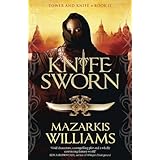
My review of " Knife Sworn" by Mazarkis Williams
A story which envelopes and entrances
Not just the first book I've finished in 2014, but the first fantasy book I've finished in a while.
I had been struggling my way through books by two different writers. Such towering figures within the genre that my travails of readership left me wondering "is it me?" So I turned at last to Knife Sworn book two in Mazarkis William's trilogy and found at last a book that could have me turning the pages in eagerness to see what happened next, yet still determined to make sure I caught every word.
In the Emperor's Knife I had been intriged by the world Mazarkis had imagined - a Cerani Empire built on rigid hierarchies and the most absolute of absolute monarchies. It had at once the air of mystery bound by threads so familiar they felt like strands of our own history.
In Knifesworn the world building is complete from a reader's perspective and the story plunges abruptly into themes of world destruction as the Emperor Sarmin finds threats of every kind assail him from without and from within to the point where even the one person he should be most sure of turns out to be the one most likely to betray him.
The theme of "the pattern" from the Emperor's knife is revisited and developed. I liked the idea that there had been a kind of value in the way that the pattern bound people together in a collaborative entity which leaves some survivors bereft and lonely. It put me in mind of my dim grasp of William Blake's railing against the imprisonment of man in the mental prison of his own individuality sampling the world through five imperfect senses.
The magic and the mystery are not laboured; Mazarkis Williams offers no lectures on her world's systems, no disconcerting authorial asides to the reader. It is a story that you experience through the eyes and ears of its protaganists seeing and feeling only what they do. You are swept along the narrative river and sometimes you might wonder at some feature that has flown by, but all the threads converge at the end.
Not just the first book I've finished in 2014, but the first fantasy book I've finished in a while.
I had been struggling my way through books by two different writers. Such towering figures within the genre that my travails of readership left me wondering "is it me?" So I turned at last to Knife Sworn book two in Mazarkis William's trilogy and found at last a book that could have me turning the pages in eagerness to see what happened next, yet still determined to make sure I caught every word.
In the Emperor's Knife I had been intriged by the world Mazarkis had imagined - a Cerani Empire built on rigid hierarchies and the most absolute of absolute monarchies. It had at once the air of mystery bound by threads so familiar they felt like strands of our own history.
In Knifesworn the world building is complete from a reader's perspective and the story plunges abruptly into themes of world destruction as the Emperor Sarmin finds threats of every kind assail him from without and from within to the point where even the one person he should be most sure of turns out to be the one most likely to betray him.
The theme of "the pattern" from the Emperor's knife is revisited and developed. I liked the idea that there had been a kind of value in the way that the pattern bound people together in a collaborative entity which leaves some survivors bereft and lonely. It put me in mind of my dim grasp of William Blake's railing against the imprisonment of man in the mental prison of his own individuality sampling the world through five imperfect senses.
The magic and the mystery are not laboured; Mazarkis Williams offers no lectures on her world's systems, no disconcerting authorial asides to the reader. It is a story that you experience through the eyes and ears of its protaganists seeing and feeling only what they do. You are swept along the narrative river and sometimes you might wonder at some feature that has flown by, but all the threads converge at the end.
Subscribe to:
Posts (Atom)